VAT in Poland made clear and simple


Home  >> Poland VAT Tax
I would highly recommend their services to any business selling goods online, especially if you have international sales.
Charlie, GB
Poland
CurrencyPolish złoty (PLN, zł)  
LanguagesPolish
Largest MarketplaceAllegro.pl
Most Popular Product CategoryFashion and Accessories
Tax Authority Krajowa Administracja Skarbowa (KAS) / The National Revenue Administration
VAT RatesStandard – 23%
Reduced – 8%
Super Reduced – 5%
Poland (the Republic of Poland) is one of the largest countries in the EU by both population and land area. VAT was first implemented in Poland in 1993, eleven years before they joined the EU in 2004.

Latest poland GST News

06 June 2025

GST relief for first-time home buyers on new homes valued up to $1.5 million

Canada’s new GST relief offers first-time home buyers a full rebate on the federal GST for newly built homes valued up to $1 million, with a partial rebate on homes up to $1.5 million. This move aims to make homeownership more affordable for eligible buyers.
06 June 2025

Prime Minister Carney will eliminate GST for first-time homebuyers

Canada is in a housing crisis – demand has gone up, supply has not kept pace, and prices are too high. The new government of Canada is taking immediate action to address this crisis.

Do I need to register for VAT in Poland? 

Whether you need a VAT number in Poland depends on: 
  • Where you’re based
  • Who your customers are (B2C or B2B)
  • What you’re selling (goods or services)
  • Where you’re selling it (on your website or an online marketplace)
  • And if you’re selling goods, where they are when they’re sold
  • The quickest way to know is to ask. Schedule a call with a member of our team and tell them about your business. They’ll help you work out whether you need to register for anything in Poland. 

My B2C business is based outside the EU

Whether you need to register for VAT in Poland depends on where your goods are, and where you’re selling them.

Selling goods on your website

You have to register for VAT in any EU country where you’re storing goods. So, if you’re storing goods in Poland, you’ll need to register there. If your goods are warehoused elsewhere in the EU and you’re shipping them to customers in Poland, you have two options:
Which registration would be better for you will depend on your current situation and your plans for your business.
Not sure which you need? Talk to us about your situation.

Importing goods to Poland

Are your goods outside the EU when your customer buys them? 
You have three options:
Register for VAT in Poland
Ship your goods to Poland Delivered at Place (DAP)

An IOSS registration allows you to import goods with an intrinsic value of EUR 150 or less to customers all over the EU – not just Poland.

If your average order from Poland has an intrinsic value over EUR 150 registering for VAT might be more efficient.
You can also ship your goods to Poland DAP. Shipping DAP puts the responsibility for Import fees, duties and VAT on your customer. We really only recommend doing this if you have one-off or infrequent high-value sales to Sweden. Shipping DAP is generally a worse experience for your customers. It increases cart abandonment and reduces repeat customers.
Not sure which is the best option? Talk to us about your business and we’ll help you work it out.

Get shipments through 
Polish customs fast with IOSS

IOSS gets your low value packages through EU customs and to your customers quickly. We can get your IOSS number to you in as little as three working days. Start your registration now and start shipping to Poland next week.

Selling goods to Poland on an online marketplace

Online marketplaces like Amazon or eBay are responsible for collecting and remitting the VAT on certain sales on their platforms. 

Marketplaces are responsible for the VAT when:
You, the seller, are based outside the EU
The sale is B2C
The goods are shipped from outside the EU in shipments with an intrinsic value of EUR 150 or less
Or the goods are in the EU at the point of sale
For example, you’re an Amazon seller based in Canada. Your stock is in your warehouse in Edmonton, AB. Your customer in Poland orders a EUR 100 hat from you. Amazon charges your customer Polish VAT and remits it to KAS.
You’ll still need to register for VAT if your goods are stored in the EU (if you’re using Amazon FBA, for example).
If you’re shipping an order with an intrinsic value of more than EUR 150 to Poland, you have two options:
Register for VAT in Poland
Ship the order DAP

VAT for Amazon Pan-EU

Every day we help Amazon sellers expand their businesses into Europe through Pan-EU FBA. We take care of VAT registrations and returns, so they can concentrate on getting more sales.
Get Pan-EU VAT sorted with the ecommerce industry’s favourite customer service.

Selling Digital Services and Digital Goods to Poland

For VAT purposes, the EU considered everything that’s not a physical object, a service. Digital services are a category of services that are defined by being “electronically supplied”. That covers things like eBooks, PDFs of sewing patterns, on-demand video courses and tickets to livestreams. If you’re in Canada or the USA, you’ll probably know these things as “Digital Goods”.
To sell digital services to customers in Poland you can either:
Register for VAT in Poland

Register for Non-Union OSS

Determining whether your services are “electronically supplied” can be complicated and has big consequences – if they’re not, you don’t need to register for anything. We recommend you talk to an expert if you’re selling digital services just to make sure.

My B2C business is based in the EU

This information only applies if you’re not based in Poland.

Selling Goods

Being based in the EU, you can make up to 10,000 EUR in sales to other EU countries before you have to register for anything. That depends, however, on where your goods are when your customer makes their purchase. 

My Goods are in Poland

Storing goods in Poland creates a “taxable supply”. You’ll need to register for VAT in Poland or for One Stop Shop (OSS) in the country where you’re based.

My Goods are in the EU, but not in Poland

If you hold stock in the country where you’re based you can choose to either register for VAT in Poland, or for OSS.

Storing goods in another country creates a VAT obligation. For example, if you store goods in France and sell them to Poland, you have a VAT obligation in both countries. You can register for VAT in both countries or skip the individual registrations and just register for  One Stop Shop.

My goods are outside the EU

You have three options when your goods are outside the EU at the point of sale:
  • Register for VAT in Poland
  • Register for Import One Stop Shop (IOSS)
  • Make your customer the Importer of Record
    Making your customer the Importer of Record will mean their order gets hold at customs until they’ve paid any duty and VAT due. If they don’t pay in time, the order will get sent back to you.

Selling Services from the EU to Poland

In the EU, anything that’s not a physical object is considered a service (for VAT purposes). It covers everything from catering services to digital downloads. Selling services to consumers in other EU countries requires you to register for OSS. You can do that through your local tax authority.


Need a quick answer? Take the EU VAT Quiz

Find out in less than a minute if you need to register in the EU and what for – IOSS, OSS, Non-Union OSS or VAT. 

VAT on Sales to Polish Businesses

When your customers are other businesses, your VAT obligations change. You might still have to register for VAT (if you store goods in Poland, for example) but in many cases the VAT is your customer’s obligation.

I’m based outside the EU and selling B2B to Poland

If you’re based outside the EU and your customer is VAT registered, the reverse charge mechanism often applies. You include “reverse charge mechanism” on the invoice, and they account for it on their VAT return.

I’m based in the EU and selling B2B to Poland

Generally, B2B sales between EU states are zero-rated if both you and your customer are VAT registered. Selling to a business in Poland from another EU country doesn’t necessarily require you to be registered there.
However, you do have to:
Be VAT registered where you’re based
Add the transaction to your EC Sales List
Verify your buyer’s VAT number on VIES

Get an international VAT expert in your corner

Whether you’ve started businesses in the EU or you’re making plans, we can help you make your VAT expenditure as efficient as possible.
Make sure you’re not paying VAT when you don’t have to with some expert advice.

How do I register for VAT in Poland?

You don’t need to incorporate a company or have an address in Poland to register for VAT. However, you will need to apply for a Polish Tax Identification number – a NIP. Finally, if you’re not based in the EU or the UK, you’ll need a fiscal representative. 
Once you have your NIP, you’ll need to submit it and several supporting documents with your application. You’ll need:
  • The documentation of your business on your local commercial registry
  • A copy of your partnership agreement (if you have one)
  • Confirmation of your taxpayer status in the country where your business is based
  • Documents showing your legal right to any property or premises your business might hold in Poland
  • Bank account statements, to help establish your identity and business activity
  • Your Power of Attorney documents, if you have a fiscal representative
It’s optional, but you can also submit a Statement of Planned Activity. It shows KAS why you need to register. It might speed up the registration process by pre-emptively answering any questions they may have about your application.
Everything you submit has to be originals and translated into Polish. KAS only accepts wet signatures. That means whenever the documents require your company’s directors to sign them, they have to put pen to paper. Plus, all your directors will need to sign the paperwork (but only up to three, if your company has more than this).
On average it takes two to three weeks for KAS to process your registration, once they’ve received your application.

VAT Essentials: Poland

Get everything you need to know about VAT to get started selling in Poland from our complete guide.

Polish VAT Returns

In Poland, VAT returns are usually filed monthly. Quarterly submissions are available, but only in specific circumstances. KAS will contact you if they want you to file quarterly.
The filing and payment deadline is the 25th day of the month following the reporting period. For example, the 25th of April is the deadline for March’s return. You can request an extension, but they’re only ever granted in exceptional circumstances, such as natural disasters, or severe illness. You’ll have to apply in writing before the deadline, or your request will be automatically rejected.

Intrastat Thresholds Poland

Intrastat is a statistical report used by the EU to collect and analyse data on the movement of goods between EU Member States. The threshold for filing an Intrastat report in Poland is PLN 6,000,000 in arrivals and PLN 2,800,000 in dispatches. 
Intrastat reports are really different to VAT returns. They’re transactional, reported by SKU and they require so much extra data - like weight, commodity codes and net sales value. You don't have to deal with the burden of compiling and filing them if you don’t want to. We can do it for you.

Polish Invoice Requirements

When you make a sale, you need to issue two copies of the invoice and give one to your customer. VAT invoices aren’t mandatory if the sale is B2C. If you deal exclusively in VAT-exempt goods, you don’t need to issue an invoice (we still recommend you do).
Invoices can only be issued between thirty days before and fifteen days after the end of the month in which you provided the goods or services. They can be in any currency, but the VAT has to be in Polish Złoty (PLN/zł).
Otherwise, Poland’s invoicing requirements follow the EU VAT Directive. Invoices need to include:
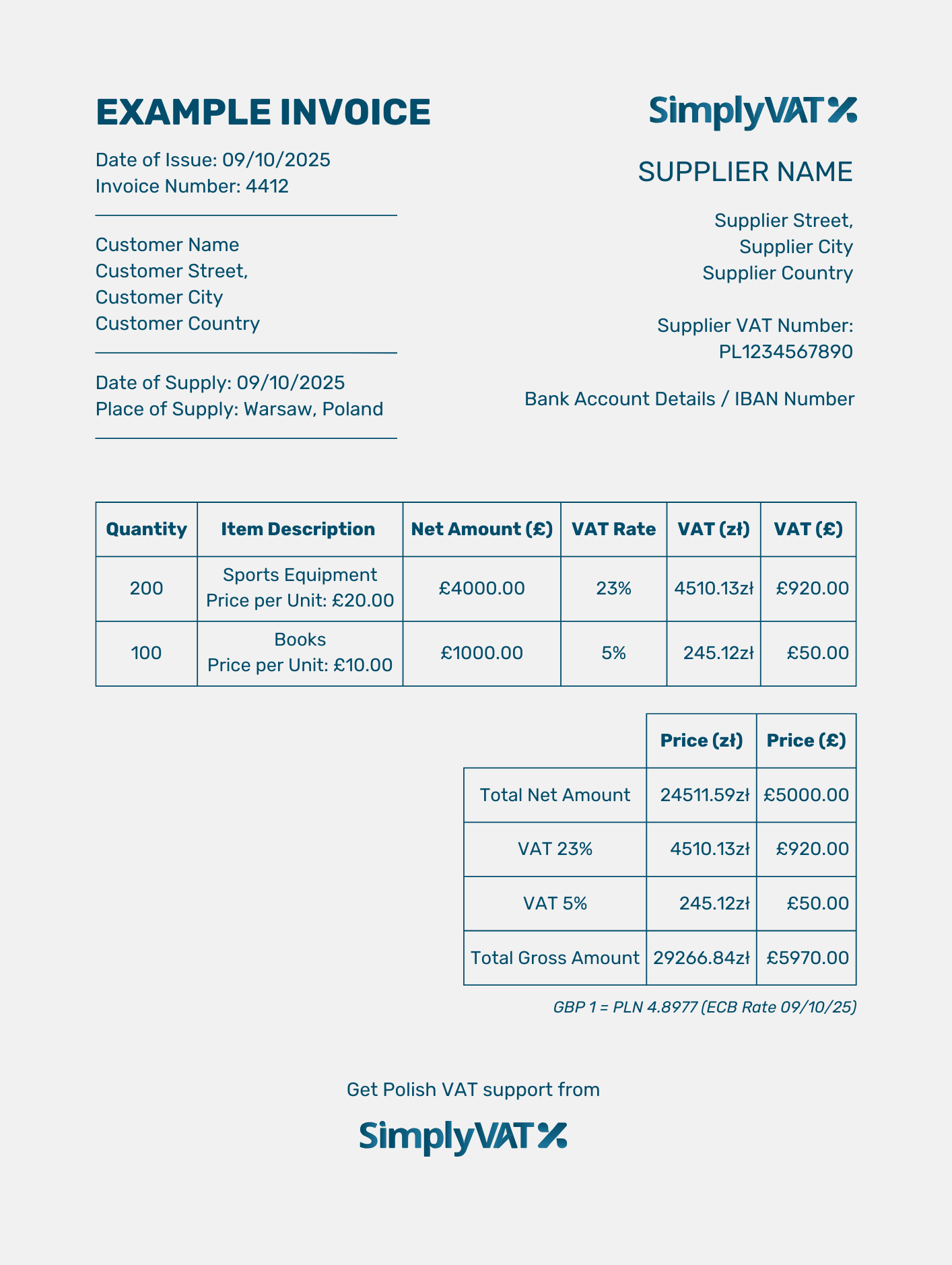
The date (if the transaction date is different to the date the invoice was issued, include that too)
A unique invoice number (they need to be issued in order)
Your VAT number
The full name and address of both you and your customer
A full description of the goods or services
The quantity and unit price, if they apply
Details of any discounts you may have applied
The net taxable value, and the gross amount of the invoice
The VAT rate you applied and the amount of VAT

Polish VAT Refunds

If you’re registered for VAT in Poland, you can claim back your input VAT on your Polish VAT return. You should make the claim in the same period that you paid the input VAT, though you can also do it in:
The next three months (for monthly filings)
The next two quarters (for quarterly filings)
If you miss the window, you’ll have to go back and amend the return for the period where you incurred the expense. For example, you pay input VAT in Poland in July. You have until October to reclaim it. After that you’ll have to amend your July return.
If you have more VAT to reclaim than you have to pay, you can either:
Carry the difference over to the next reporting period
Have the difference refunded to you
KAS will only pay refunds into Polish bank accounts. In our experience, opening a bank account in Poland costs several thousand euros. You have to go to Poland and instruct a lawyer and notary to prepare your application. You also have to open the account in person, which can require a second trip. It only makes sense if you have a large amount to refund.

Refunds when you’re not VAT registered in Poland

If you’re not registered for VAT in Poland, you can still get a VAT refund. How you do it depends on whether you’re based in the EU or not.
Businesses based in the EU can use their national tax authority’s online portal to use the EU Refund Directive. Once the claim has been processed, KAS will refund you the money.
If you’re not based in the EU, you’ll need to use the 13th Directive.

13th Directive VAT Refunds in Poland

To use the 13th Directive, the country where you’re based must have a reciprocity agreement with Poland.
You can only claim for a period of three months or a year. If you’re claiming for three months, the minimum amount you can claim is EUR 400. If you claim for the whole year, the minimum decreases to EUR 50. You have until the 30th of September the year following the refund period to make your claim. For example, the deadline to refund VAT paid in April 2024 is September 2025.  
VAT refunds for non-EU companies are admin-intensive and can take a long time. If you’d like a refund but don’t want to spend time chasing it, we can handle it for you.

Vat services trusted by thousand of ecommerce brands

4.8
We love VAT, so you don’t have to!

Poland VAT FAQs

How do I get an EORI number?

We can get you an EORI number and help you decide which country you should register in. We’ll need some details about your business, so book a call and we’ll get things started.

How do I get an EORI number
What’s the cost of an EORI number?
EORI number processing time:

We can get you an EORI number and help you decide which country you should register in. We’ll need some details about your business, so book a call and we’ll get things started.

Tab Content #2
Tab Content #3

Poland VAT Rates

  • Standard: 23%
  • Reduced: 8%
  • Super Reduced: 5%
If you’re not based in the EU or UK, you need a fiscal representative to register for VAT in Poland.
On average it takes KAS two to three weeks to process your application once they have all your documents.
In Poland Value Added Tax is known as the Goods and Services Tax or Podatek od Towarów i Usług (PTU)

Learn more about VAT


Top 10 Ecommerce Trends for 2026


Top 10 Reasons You Should Expand into the EU in 2026


Top 10 VAT Audit Questions Answered
Find out more

Top 10 Intrastat Reporting Questions Answered 
Find out more

5 Things to Consider When Shipping to EU Countries
Find out more

Ecommerce News December 2025


DAP vs DDP: How Should You Ship Your Orders?
Find out more

How to Get a VAT Refund in Europe


IOSS Number FAQs
Find out more
March 19, 2025
Influencer Tax: Do Online Creators Pay VAT?
March 18, 2025
Do UK Sellers Pay US Sales Tax?
March 18, 2025
Why brand protection is Essential for Ecommerce business
March 19, 2025
Influencer Tax: Do Online Creators Pay VAT?
March 19, 2025
Influencer Tax: Do Online Creators Pay VAT?
© 2025 Borderfree Trade Ltd | Company Reg 8216948
Privacy PolicyCookie Policy
Stay Connected:
menu